The story of Culver City has been one shaped by different figures over its history, and we see many of their names plastered across the city. There’s Ince, Youngworth, Dixon, and the city’s namesake, Culver. Two names perhaps under-discussed, considering their impact, are Lewis Astin Crank and R.J. Blanco.
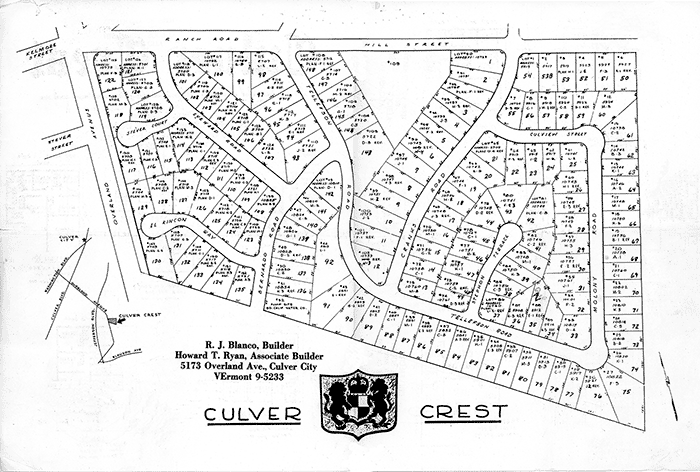
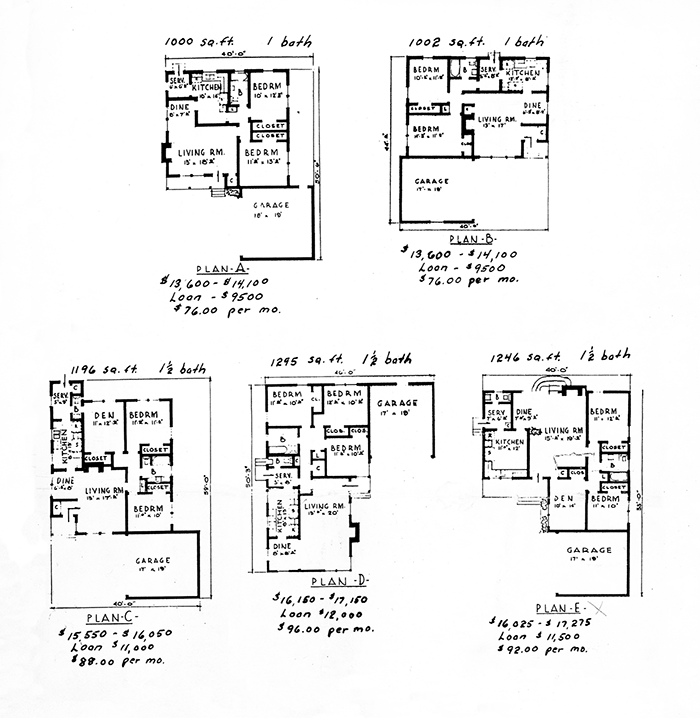
Between 1952 and 1956 the pair — Crank, a businessman and developer with a somewhat colorful past, and Blanco, a veteran contractor — developed what would become the Culver Crest/Blanco Park neighborhoods. Culver Crest was a chic, postwar development, offering tract homes that were considered large for the time and provided a view of the city that no other property could. Blanco Park homes were modest and affordable for most.
For their efforts, Blanco, Crank, and their associates left their names throughout the city. There is, of course, Blanco Park on Sawtelle, as well as Cranks Road. There’s also a handful of other notable names throughout the neighborhood, including Tellefson Road, named after Mike Tellefson, past city attorney, council member and mayor. Lugo Way honors the Lugo family, whose long history in the La Ballona Valley goes back to the days of the Spanish land grants.
Perhaps most interesting are Esterina Way and Linda Way, named for Lewis’s first wife Esther and daughter Linda from his second wife, Alungalelei Fifita. Esther Crank has her own connections to southern California history, as she was the sister (and alleged silent partner) of famed gambler/gangster/gadfly Tony Cornero.
“Tony the Hat” is best known for his role as the “admiral” of a small fleet of gambling ships that sailed on Santa Monica Bay in the early 1930s. Culver City comes back into the picture in 1946 when Edmund G. Brown (future attorney general and governor) alleged that LAC Chemicals on National Ave. was a front for an illegal distillery that was owned (in name only) by Lewis, Tony’s mother and one of his sisters.
These more salacious aspects of Crank’s youth shouldn’t overshadow the rest of his life. In 1945, Lewis Crank purchased 30 acres of land from Grace Moore, opera star and MGM actress. The area atop the Baldwin Hills included a beautiful Mediterranean-style home built in 1928 by former Democratic candidate for U.S. Senate Leo V. Youngworth. Lewis and his wife Esther lived at the estate until 1954. When they moved to a new home, Crank sold the mansion to the Catholic Archdiocese of Los Angeles. This would become Marycrest Manor.
Blanco went on to sponsor a local women’s softball team, while Crank got into equestrian sports and boat racing (he even re-used Esterina as the name of his boat). After raising their children, Lewis and second wife Alungalelei relocated to her native country. Lewis passed away in 1990 and is buried in Kolovai, Tongatapu, Tonga alongside his wife.
Besides the neighborhood Lewis Crank helped build and name, another nod to his legacy is his children, residents of Culver City for many years.
This is by no limits a complete collection of our city streets, or even those of Culver Crest/Blanco Park, but it is a healthy reminder that history is often something we take for granted. At least in this case, somebody was kind enough to attach a name to it.
R.J. Blanco and other significant figures of Culver City history will be detailed in future columns.